Untouchable Domains.
There are three well-tested ways to kill state-sanctioned projects that have gone rogue.

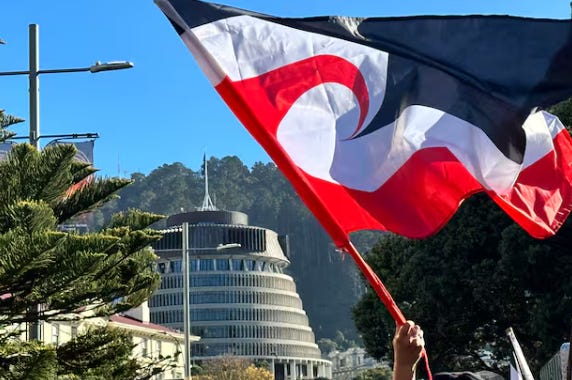
“IF YOU WIN and nothing changes – what’s the point?” It’s a question often posed by activists on the left of New Zealand politics, and now, after nearly three years of the National-Act-NZ First coalition government, it is also being asked, with increasing urgency, by activists on the right. Their target, overwhelmingly, is National.
In the words of “Pee Kay”, posted on Don Brash’s and Lindsay Mitchell’s website Brash & Mitchell under the heading “National … the Enemy Within?”:
“Through generations of, what can only be regarded as deliberate political deceit, a succession of National Prime Ministers have quietly laid the institutional foundations for the seemingly untouchable Maori corporate and political domain that is dominating the political landscape we are confronted with today.”
These are strong words, but the historical record more than bears them out. National’s solution to the economic stresses that had overtaken both provincial and urban Māori communities in the late-1980s as a consequence of Rogernomics, and which had become even more acute following Ruth Richardson’s 1991 “Mother of All Budgets, was indeed to erect a Māori corporate “domain” with the Treaty of Waitangi at its heart.
National’s aim was simple: prevent at all costs the political mobilisation of urbanised Maori workers. Their solution, equally straightforward, was to resurrect the rural-based, quasi-aristocratic structures of historical iwi and hapu; fund them with “Treaty Settlements” amounting to hundreds-of-millions of taxpayer dollars, and wait for the new Māori middle-class needed to administer these massive pools of capital to take shape.
Professor Elizabeth Rata dubbed the result “neo-tribal capitalism”. National had created a “Māori corporate domain” that was sufficiently well-resourced to operate independently of the overwhelming majority of Māori living in New Zealand’s cities.
It was an elegant and largely self-sustaining solution. The best and the brightest of Maoridom could be plucked from their communities (where they might otherwise have matured into potentially dangerous political agitators) and inducted into the new iwi structures. In addition to the professionals and managers required to run their rapidly expanding businesses, these resurrected iwi were also eager to implant a fifth column of culturally and politically primed mana whenua in the core institutions of Pakeha society.
It worked. Between 1990 and 2023 the Pakeha elites (operating through both the National and Labour parties) successfully established what amounted to a Māori auxiliary elite, one whose entire existence rested upon its “partnership” with the Crown – as defined by the radically revisionist readings of the Treaty emerging from the universities and the courts. This elite-driven bi-culturalism constituted the Crown’s (i.e. the state’s) best hope of keeping the restive urban Māori majority poor and powerless.
Keep reading with a 7-day free trial
Subscribe to Chris Trotter to keep reading this post and get 7 days of free access to the full post archives.